Why Most Acquisitions Fail — and How to Beat the Odds
The statistics are stark: roughly 70% of acquisitions fail to create the value that was promised. Harvard Business Review has documented this pattern extensively, and McKinsey’s M&A research confirms that integration failure and cultural mismatch are the primary culprits. For SME owners — whether you’re buying or being acquired — understanding why deals fail is the best way to make sure yours doesn’t.
The Three Ways Deals Go Wrong
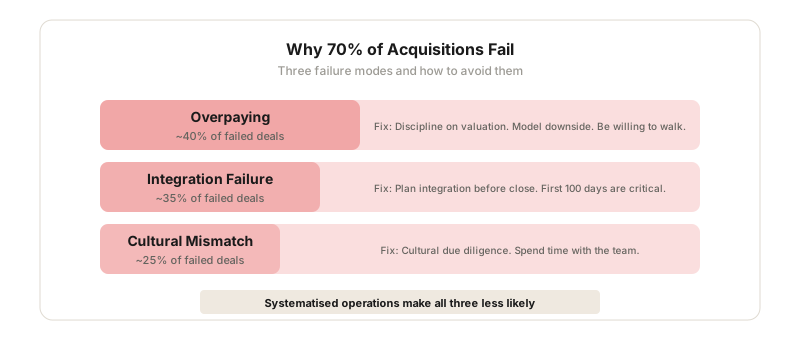
After 17 years in M&A advisory, we’ve seen deals fail for many reasons. But they almost always fall into three categories:
1. Overpaying
The most common mistake — and the simplest to understand. A buyer falls in love with a target, gets caught up in competitive tension, or relies on projections that are more aspirational than realistic. They pay 7x for a business that should have been 5x, and spend the next five years trying to grow into a valuation that was too high from day one.
The fix is discipline. Have a clear thesis for why the acquisition creates value. Model the downside case, not just the upside. And be willing to walk away — the best deal you ever do might be the one you don’t.
2. Integration failure
This is where the real damage happens. Two businesses that looked complementary on paper turn out to have incompatible systems, cultures, or processes. Clients get confused. Staff get frustrated. The synergies that justified the price never materialise because nobody planned for how the businesses would actually come together.
Integration planning should start before the deal closes — not after. The first 100 days post-close are critical: systems integration, team alignment, client communication, and process harmonisation all need to happen fast and deliberately.
3. Cultural mismatch
The most underestimated risk. You can merge two businesses with perfect strategic logic, and it still fails if the people don’t work well together. A high-performance culture acquiring a lifestyle business — or vice versa — creates friction that no spreadsheet model can predict.
Cultural due diligence is just as important as financial due diligence. Spend time with the management team. Understand how decisions get made. Ask what happens when things go wrong. The culture of the combined business will determine whether the acquisition creates value or destroys it.
The Buy-and-Build Strategy
For SME owners looking to grow by acquisition, the buy-and-build model is one of the most powerful strategies available — when done right. The idea is straightforward: acquire smaller competitors, integrate them onto a common platform, and create a business that’s worth more than the sum of its parts.
The key word is “platform.” Each acquisition should integrate into shared systems — shared technology, shared back-office, shared processes. Without that platform, you’re not building a business — you’re collecting businesses. And a collection of loosely connected companies isn’t worth a premium.
Where Technology Makes the Difference
The biggest change we’ve seen in SME acquisitions over the past few years is the role of technology in integration. Businesses that have automated, systematised operations are dramatically easier to integrate than those running on manual processes and spreadsheets.
When you acquire a business with clean data, automated workflows, and documented processes, integration takes weeks instead of months. Client disruption is minimal. Staff can be onboarded quickly. The synergies actually happen.
When you acquire a business where everything lives in people’s heads and Excel files, integration is a nightmare. It takes twice as long, costs twice as much, and you lose clients and staff in the process.
Advice for Sellers
If you’re on the selling side, here’s what this means for you: the more systematised your business is, the more attractive it is as an acquisition target. Buyers are looking for businesses that are easy to integrate. Automated operations, clean data, and low key-person risk don’t just increase your standalone valuation — they make you the preferred target in a competitive process.
Advice for Buyers
If you’re looking to grow by acquisition: build your platform first. Get your own house in order — automate your operations, build your management team, systematise your processes — before you start acquiring. A strong platform makes every subsequent acquisition faster, cheaper, and more likely to succeed.
At Amafi Capital, we help portfolio companies on both sides of this equation. We build the technology platform that makes acquisitions integrate smoothly, and we bring the M&A experience to source, negotiate, and close the right deals. If you’re thinking about growth-by-acquisition, we should talk.
Planning to grow by acquisition? Amafi Capital builds the technology platform that makes integrations work, and brings 17+ years of M&A experience to source and close the right deals. Talk to us about your buy-and-build strategy.