What Private Equity Partners Actually Do
Private equity has a perception problem. The headlines are full of leveraged buyouts, cost-cutting, and asset-stripping. But in the lower middle market — where most SMEs operate — the reality of a good PE partnership looks nothing like that.
The Headline Version vs. Reality
When people hear “private equity,” they think of billion-dollar leveraged buyouts — firms loading up a company with debt, slashing costs, and flipping it in three years. That model exists, but it’s largely a big-company phenomenon.
In the lower middle market — businesses with $1M to $10M in EBITDA — private equity looks completely different. As Investopedia explains, lower-middle-market PE firms typically focus on operational improvement rather than financial engineering. The best firms are growth-oriented partners who bring capital, expertise, and operational support to help good businesses become great ones. The relationship is collaborative, not adversarial.
What a Good PE Partner Brings
— Capital without the bank constraints. Growth capital that doesn’t come with personal guarantees, restrictive covenants, or monthly principal repayments. Equity capital is patient — it’s there to fund growth, not to be repaid on a schedule.
— Strategic thinking. A good PE partner has seen dozens of businesses in your industry. They know what works and what doesn’t. They can help with pricing strategy, market positioning, geographic expansion, and identifying acquisition targets.
— Operational capabilities. This varies by firm. Some provide CFO support and financial discipline. Some bring sales and marketing expertise. At Amafi Capital, we bring an AI and automation team — engineers who embed inside the business and build systems that improve operations.
— M&A execution. If growth-by-acquisition is part of the plan, a PE partner handles the deal sourcing, valuation, negotiation, and integration — work that would otherwise consume the owner’s time and require expensive advisors.
— Governance and accountability. Regular board meetings, clear KPIs, and structured reporting. This isn’t bureaucracy — it’s the kind of discipline that makes businesses more valuable and less dependent on any one person.
Red Flags to Watch For
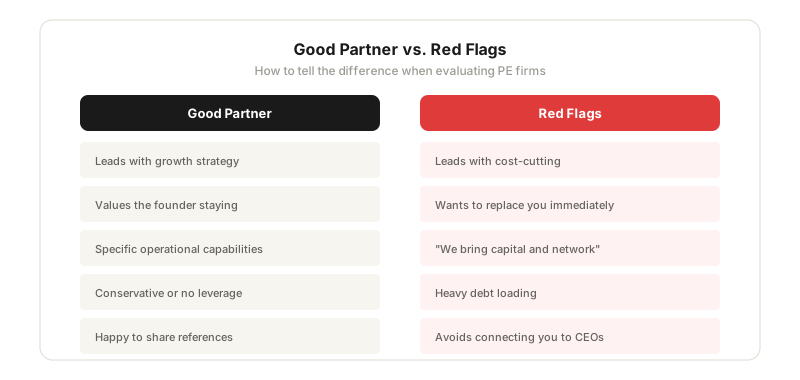
Not all PE firms are good partners. Here’s how to tell the difference:
— They lead with cost-cutting. If the first conversation is about reducing headcount and renegotiating supplier contracts, that’s a signal. Good partners lead with growth — cost discipline follows naturally.
— They want to replace you immediately. Some firms buy businesses to install their own management team from day one. If you want to stay involved, make sure the partner values that — and structures the deal accordingly.
— They can’t explain how they add value. “We bring capital and network” is not a value proposition. Ask for specific examples of what they’ve done in portfolio companies. If they can’t point to concrete outcomes, they’re a financial investor, not a partner.
— They over-leverage. Bain’s research shows that the best-performing PE deals in the lower middle market use conservative capital structures. Excessive debt is how PE destroys businesses. A good lower-middle-market partner uses conservative leverage — or no leverage at all — because the growth plan relies on operational improvement, not financial engineering.
How to Choose
The most important question to ask a potential PE partner is: “What will be different about my business in three years because of your involvement?” If the answer is just “more capital” or “a bigger balance sheet,” keep looking. The right partner should be able to articulate specific operational and strategic improvements they’ll drive.
Talk to their existing portfolio company owners. Ask what the partnership actually feels like day-to-day. Ask what surprised them — both positively and negatively. The best reference checks happen when the PE firm isn’t in the room.
At Amafi Capital, we’re transparent about what we do and how we work. If you’d like to understand what a partnership could look like for your business, reach out. We’ll give you an honest answer — even if that answer is “we’re not the right fit.”
Want to know what a PE partnership actually looks like? Amafi Capital brings growth capital plus an embedded AI team to every portfolio company. Have an honest conversation with us — we’ll tell you if we’re the right fit, and if we’re not, we’ll tell you that too.