What Is Your Business Actually Worth?
Most business owners have a number in their head — what they think their company is worth. That number is usually wrong. Not because they don’t know their business, but because they’re thinking about value differently than the people who would buy it.
The Multiple Is Not the Whole Story
When people talk about business valuation, they usually land on a multiple of EBITDA. “My business does $2M EBITDA, and I’ve heard businesses like mine sell for 5x, so it’s worth $10M.” This is a useful starting point and a dangerous endpoint.
The multiple itself is a compression of dozens of factors into a single number. As Investopedia notes, EV/EBITDA multiples vary significantly by industry, growth rate, and risk profile. Two businesses with identical EBITDA can trade at wildly different multiples depending on growth rate, customer concentration, recurring revenue, margin stability, and — increasingly — how systematised their operations are.
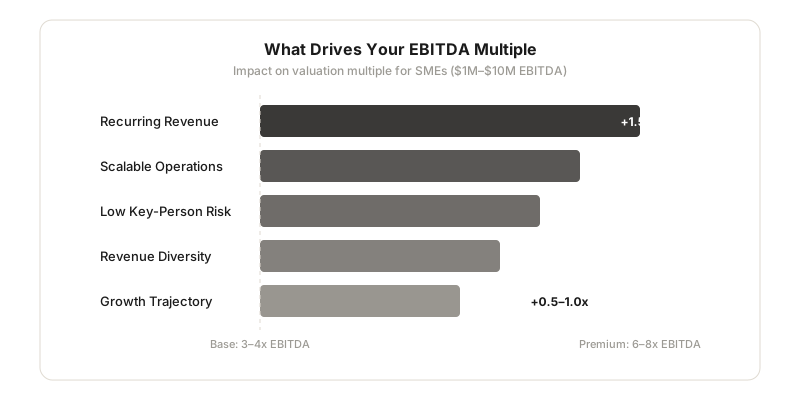
What Actually Drives the Number Up
Buyers and investors are paying for future cash flows, adjusted for risk. Everything that makes those cash flows more predictable and more scalable pushes the multiple higher. The biggest drivers we see:
— Recurring or contracted revenue. A business with 80% recurring revenue is worth materially more than one that starts from zero each month. Predictability reduces risk, and reduced risk increases multiples.
— Low customer concentration. If your top client is 30%+ of revenue, that’s a risk factor. Buyers will discount for it — sometimes heavily.
— Scalable operations. Can the business grow without linearly adding headcount? Businesses with automated workflows, documented processes, and data-driven decision making command premiums because they’re easier to scale post-acquisition.
— Low key-person risk. If the business stops functioning when the owner goes on holiday, it’s worth less. Full stop. Harvard Business Review research consistently shows that buyer confidence in business continuity is one of the strongest drivers of premium valuations.
The AI Factor
Here’s what we’re seeing change: businesses that have invested in AI and automation are starting to command higher multiples. Not because “AI” is a buzzword, but because the operational improvements are real and measurable — lower cost bases, faster client delivery, better data, and less dependency on specific individuals.
A professional services firm that automates its reporting, onboarding, and client communications isn’t just more efficient. It’s structurally more valuable because a buyer can see exactly how the business scales without proportionally scaling costs.
Getting an Honest Answer
The best way to understand what your business is worth is to talk to someone who buys businesses for a living — not a broker trying to win your listing with an inflated number, and not a free online calculator that knows nothing about your market.
At Amafi Capital, we’re happy to have an honest, no-obligation conversation about valuation. We’ll tell you what we think your business is worth, what’s driving that number, and what you could do to improve it — whether or not we end up working together.
Want an honest view of what your business is worth? At Amafi Capital, we help business owners understand their valuation, what’s driving it, and what they can do to improve it. Start a conversation — no obligations, no inflated numbers.