The Owner's Dilemma: When to Let Go
You built this business from nothing. It’s your identity, your legacy, your financial security. And now you’re wondering whether it’s time to do something different. That’s one of the hardest questions an entrepreneur ever faces — and there’s no formula for the answer.
The Signs Most Owners Ignore
Nobody wakes up one morning and decides they’re done. It’s a gradual shift — one that most owners resist acknowledging because the alternative feels terrifying. But the signs tend to follow a pattern:
— The problems stopped being interesting. You used to find energy in solving business challenges. Now the same problems keep recurring and you can’t summon the enthusiasm to fix them properly.
— You’re the bottleneck and you know it. The business needs investment in technology, or a new sales approach, or expansion into a new market — and you know you’re not the right person to lead that change.
— Your risk tolerance has changed. When you started, you could bet everything because you had nothing to lose. Now you have employees, clients, and a family depending on you. The risk calculus is different.
— You’re thinking about it constantly. If the question of “what’s next?” occupies more mental space than the business itself, that’s telling you something.
The Timing Trap
According to Harvard Business Review, founder attachment to their business is one of the most common reasons exits are delayed past their optimal window — often resulting in materially worse outcomes.
Most owners wait too long. They tell themselves “one more year” — to hit a revenue target, to finish a project, to see if the market improves. The problem is that “one more year” has a cost. Energy declines. Innovation slows. Good people leave because they sense the stagnation. The business gradually becomes less valuable, not more.
The best time to make a transition is from a position of strength — when the business is growing, the team is strong, and you still have the energy to manage a process properly. Waiting until you’re burnt out means negotiating from weakness with fewer options.
It Doesn’t Have to Be All or Nothing
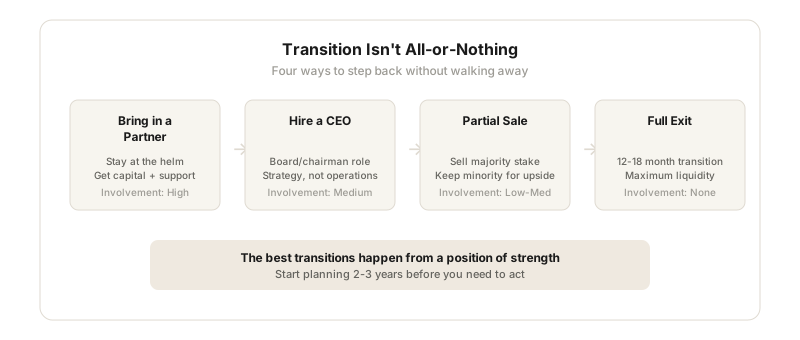
The biggest misconception is that stepping back means walking away entirely. In practice, transitions are a spectrum:
Bring in a partner. A minority investor who provides capital and operational support while you stay at the helm. This addresses the “I need help but I’m not ready to leave” scenario.
Hire a CEO. Step into a board or chairman role. Stay involved in strategy and major decisions while someone else handles day-to-day operations. You get your time back without losing the connection.
Partial sale. Sell a majority stake, retain a meaningful minority position, and earn a “second bite” when the business is eventually sold again at a higher value.
Full exit with transition. Sell 100%, stay for a 12–18 month transition period, and then move on completely. Clean break, maximum liquidity.
The Identity Question
McKinsey research on leadership transitions shows that planned transitions deliver 2–3x better outcomes than reactive ones — both financially and for the ongoing health of the business.
Here’s what nobody talks about in the deal documents: for many founders, the business is their identity. “I’m the person who built [company name]” is how they introduce themselves, how they think about themselves, how they derive purpose.
Letting go of the business means letting go of that identity — and finding a new one. The owners who navigate this best are the ones who start building their next chapter before they close the current one. Whether that’s investing, advising other businesses, pursuing interests they’ve deferred for decades, or simply spending time with family — having something to move toward makes the transition dramatically easier.
Having the Conversation
If any of this resonates, the first step isn’t making a decision — it’s having a conversation. Talk to someone who’s been through this before. Understand your options. Get an honest view of what your business is worth and what a transition could look like.
At Amafi Capital, many of our best partnerships start with this conversation. An owner who’s not sure what they want yet, but knows they want to explore. No pressure, no pitch — just an honest discussion about what’s possible. If that sounds useful, we’re here.
Thinking about what’s next? Amafi Capital partners with business owners at every stage — whether you want to stay and grow or start planning your transition. Let’s have an honest conversation.