Key-Person Risk Is Killing Your Valuation
Here’s a question every business owner should be able to answer: what happens to your business if you take three months off? If the honest answer is “it falls apart,” you have a key-person problem — and it’s costing you more than you think.
Why Buyers Care So Much
When a buyer looks at your business, they’re asking a simple question: will this business continue to perform after the deal closes? If the answer depends on the current owner showing up every day, maintaining client relationships personally, and making every operational decision — that’s an enormous risk.
And risk gets priced in. Corporate Finance Institute identifies key-person risk as one of the top qualitative factors that buyers use to discount valuations. We’ve seen businesses lose 1–2x on their EBITDA multiple purely because of key-person dependency. On a $3M EBITDA business, that’s $3–6M in lost value. It’s the single most expensive problem most owners don’t know they have.
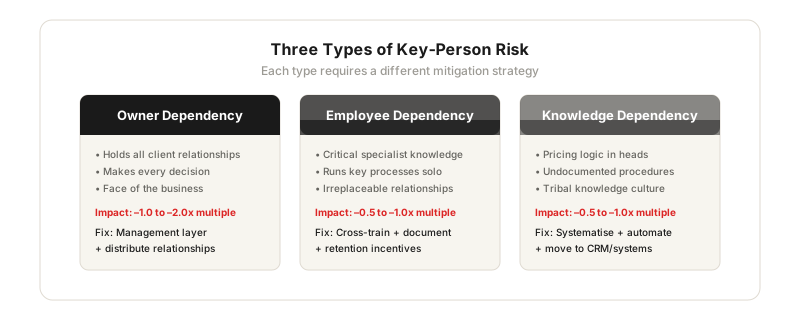
The Three Types of Key-Person Risk
Key-person risk isn’t just about the owner. It shows up in three forms:
— Owner dependency. The owner holds all the client relationships, makes all the decisions, and is the face of the business. The most common and most damaging form.
— Employee dependency. A critical employee holds specialised knowledge, key client relationships, or runs a process that nobody else understands. If they leave, a part of the business goes dark.
— Knowledge dependency. Critical information — pricing logic, client preferences, operational procedures, supplier terms — lives in people’s heads rather than in systems. This is often invisible until someone leaves.
How to Fix It
Reducing key-person risk is a systematic process, not a one-time fix. Here’s the playbook:
Build a management layer
Hire or promote people who can make decisions without you. As Harvard Business Review notes, the strongest businesses are those where leadership capability is distributed, not concentrated. Start by delegating the decisions you make most frequently — pricing, hiring, client issues, day-to-day operations. The goal isn’t to remove yourself entirely; it’s to prove the business works without you in the room.
Systematise your processes
Every process that lives in someone’s head is a single point of failure. Document them, automate them where possible, and make sure more than one person can execute them. AI is particularly powerful here — automated workflows don’t take sick days, don’t quit, and don’t forget steps.
Distribute client relationships
If you’re the only person your clients talk to, start introducing them to your team. Transition key accounts to senior employees. Make sure clients see value in the firm, not just in you personally. This takes time — which is why starting early matters.
Create institutional knowledge
Move information from heads to systems. CRM notes, documented procedures, pricing frameworks, client history, supplier agreements — all of it should be accessible to the team. When knowledge is institutional rather than personal, the business is resilient.
The Upside
Here’s the thing most owners don’t expect: reducing key-person risk doesn’t just increase your valuation. It makes your life better. When the business doesn’t depend on you for everything, you get your time back. You can think strategically instead of fighting fires. You can take a holiday without your phone buzzing every hour.
It’s one of those rare situations where what’s good for the valuation is also good for the owner. You just have to start.
At Amafi Capital, this is a core part of what we do with every portfolio company. Our AI team builds automated systems that eliminate knowledge dependency, and we work with owners to build management layers that reduce owner dependency. If you’d like to talk about what this looks like in practice, get in touch.
Is key-person risk holding back your valuation? Amafi Capital systematically reduces dependency through AI automation and management team development. Let’s assess where you stand.